

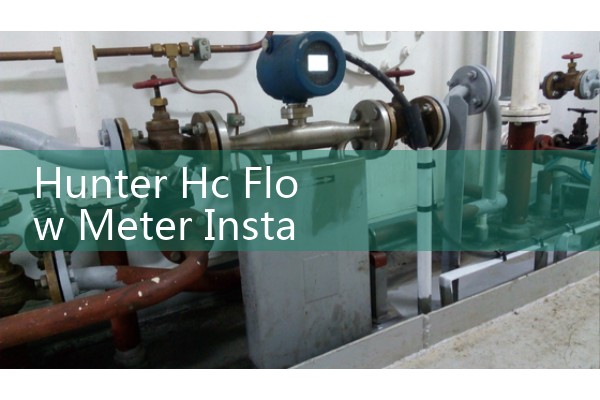
『Hunter Hc Flow Meter Installation: Plumbing Alignment Checklists to Prevent Pulse Counting False Drops』Related information(flow rotameter|digital flow meter|balo meter|hydraulic flow meter|volumetric meter|positive displacement meter|pitot tube flow meter|displacement meter|cfm meter|variable area flow meter|inline flow meter|differential pressure flow meter|calibrated flow meter|velocity meter|paddle wheel flow meter|oval gear flow meter|anemometer hvac|multiphase flow meter|doppler flow meter|thorpe tube flowmeter|heat flow meter)

Hunter Hc Flow Meter Installation: Plumbing Alignment Checklists to Prevent Pulse Counting False Drops
Quick Answer: Plumbing misalignment is the most common cause of pulse counting false drops on Hunter HC flow meters. Before you power up the meter, check flange alignment, gasket position, straight run length, pipe support, and grounding. Mechanical checks solve more false drop problems than replacing the pulse board.
Why False Pulse Drops Happen on Hunter HC Meters
Most engineers assume that a missing pulse means an electrical fault. In practice, the flow profile at the meter is often the real problem. A Hunter HC meter counts pulses from flow. If the flow profile is distorted by a misaligned flange or a protruding gasket, the pulse train can become uneven. The totalizer then shows a false drop. This is not a sensor defect. It is an installation symptom.
We have seen this on customer sites many times. One water treatment plant in the Philippines had a DN100 Hunter HC meter installed with a flange offset of 3 mm. The operator noticed eight to fifteen missing pulses per day. The meter passed its bench test. The problem disappeared after realignment.
Pre-Installation Pipe Alignment Checklist
Use this checklist before the meter goes into the line. Each step takes a few minutes and can prevent days of troubleshooting.
Step 1. Check that the upstream and downstream pipe flanges are parallel. For DN50 to DN150, the gap difference should stay under 0.5 mm across the flange face.
Step 2. Center the meter between the pipe flanges. Use alignment pins or a spirit level. Do not force the pipe to meet the meter.
Step 3. Verify the gasket inner diameter matches the pipe inner diameter. A protruding gasket creates a step. That step can trip the pulse signal at low flow.
Step 4. Tighten the flange bolts in a cross pattern. Use a torque wrench. Uneven bolt load can shift the meter by 1 to 2 mm.
Step 5. Check pipe supports on both sides. The pipe should not hang from the meter. If the meter carries pipe weight, the body can flex and change the flow path.
Step 6. Confirm straight run upstream and downstream. Short distances after elbows, pumps, or control valves cause swirl. For DN100 and smaller, keep at least 15D upstream and 5D downstream. For DN150 to DN300, keep at least 10D upstream.
Flange Alignment and Gasket Centering
Flange alignment is the fastest check. In many installations, the bolts pull the pipe into position. That leaves the flange faces at a slight angle. The meter body then sits in a small bind. At flow rates below 0.5 m/s, the pulse output can skip because the flow around the sensor is no longer symmetric.
Here is the thing. A gasket that looks close to the pipe ID may still protrude by 1 to 2 mm. That is enough to change the flow pattern near the pickup. Measure the gasket ID against the pipe ID before you install it. If the gasket is soft, check it again after the first thermal cycle. Soft gaskets can creep.
Straight Run and Flow Profile Checks
Straight run is not just a recommendation from the manual. It is the distance the flow needs to settle after a disturbance. A Hunter HC meter installed after an elbow can read normal flow while the pulse output is uneven. The totalizer may drop counts at irregular intervals, often at night when the flow changes.
For liquid applications, follow these numbers. DN15 to DN50: 15D upstream and 5D downstream. DN80 to DN200: 10D upstream and 5D downstream. If you have a partially open valve or a pump within 5D, double the upstream straight run. If space is tight, install a flow conditioner. Do not put a control valve directly upstream. A jet from a control valve can cau
Grounding, Shielding, and Pulse Wiring Check
Pulse counting false drops can also come from electrical noise. The pulse output is often a low voltage square wave. A nearby VFD cable or power cable can introduce spikes that the totalizer interprets as extra or missing pulses. Use a twisted pair shielded cable for the pulse output. Connect the shield at one end only, usually at the panel or PLC side. At the meter side, leave the shield isolated.
Check the grounding ring or grounding electrode. For water and wastewater lines, install a grounding ring on both ends of the meter if the pipe is lined or non-conductive. Do not rely on the flange bolts alone for ground. Paint, rust, or sealant often blocks the grounding path.
Common Site Examples We Have Seen
Last year a customer in Vietnam asked us why a DN80 Hunter HC meter lost pulses after a pump change. The new pump sat about 0.8 m upstream. The meter output looked stable, but the pulse total was short by about 2 percent each day. We moved the meter to a location with 12D upstream. The totalizer then matched the reference meter within 0.3 percent.
In Saudi Arabia, a water utility found that a DN150 meter lost counts only during early morning. The flange alignment was off by 2 mm and the gasket had shifted. When the pipe cooled, the gap changed enough to disturb the flow. After a laser alignment and a new PTFE gasket, the morning drop disappeared.
Recommended Silver Instruments Options
If you keep chasing false drops on a Hunter HC meter, compare it with a Silver Instruments electromagnetic flow meter. We supply DN15 to DN300 sizes with pulse output, 4-20 mA HART, PTFE lining, and 0.5 percent accuracy. For water, wastewater, chemical, and food grade liquid, the electromagnetic flow meter gives a stable pulse total when installed with proper grounding. For low conductivity fluids, consider a Silver Instruments vortex flow meter or oval gear flow meter. For high accuracy mass flow, use a Coriolis mass flow meter.
Send us your pipe size in DN, fluid type, flow range in m3/h or kg/h, pressure in bar, and temperature in °C. We will quote a meter with the correct lining, electrodes, and output. Contact Silver Automation Instruments at Tel: +86-25-68650347, WhatsApp: +86-25-52155837, WeChat: +86 15365082610.
FAQ: Hunter HC Flow Meter Installation and False Pulse Drops
Q: What is the minimum straight run for a Hunter HC flow meter installation?
A: For DN15 to DN50, keep at least 15D upstream and 5D downstream. For DN80 to DN200, keep at least 10D upstream and 5D downstream. Double these values after a pump or control valve.
Q: How much flange misalignment can cause false pulse drops?
A: A flange offset of 2 to 3 mm on DN100 or DN150 meters can disturb the flow profile enough to lose pulses. Keep the flange face gap difference under 0.5 mm.
Q: Can a protruding gasket cause pulse counting errors?
A: Yes. A gasket that protrudes more than 1 mm into the flow stream creates a step. The step can trip the pulse signal at low flow, especially below 0.5 m/s.
Q: Does grounding affect pulse output on Hunter HC meters?
A: Yes. A missing or poor ground can make the pulse signal unstable. Use grounding rings on lined or non-conductive pipes and connect the cable shield at one end only.
Q: When should I replace a Hunter HC meter instead of realigning?
A: Replace it if the meter body is cracked, the liner is worn, or the pulse output is dead after the wiring and alignment checks pass. For new installations, a Silver Instruments electromagnetic flow meter may be a better fit for DN15 to DN300 lines.
 Hot Blog
 Related AD