

_500x500.jpg)
『60 Ml/Min Flow Meter Liquid Dispensing Validation Steps』Related information(flow rotameter|digital flow meter|balo meter|hydraulic flow meter|volumetric meter|positive displacement meter|pitot tube flow meter|displacement meter|cfm meter|variable area flow meter|inline flow meter|differential pressure flow meter|calibrated flow meter|velocity meter|paddle wheel flow meter|oval gear flow meter|anemometer hvac|multiphase flow meter|doppler flow meter|thorpe tube flowmeter|heat flow meter)
60 Ml/Min Flow Meter Liquid Dispensing Validation Steps
Quick Answer: For 60 ml/min liquid dispensing validation, use a micro Coriolis mass flow meter like the Silver Instruments SCM-DN3 or a precision oval gear meter for viscous fluids. Verify the meter against a calibrated scale and repeat five times. Log raw pulses and 4-20 mA HART signals to a paperless recorder to prove traceability.
Why 60 Ml/Min Dosing Needs Its Own Validation Method
Small flow rates behave differently. A 60 ml/min stream inside a DN3 pipe cannot be validated the same way you would check a 2-inch main line. Surface tension, tiny air bubbles, and vibration from nearby pumps all shift the reading by a few percent. Most engineers skip a full validation and then wonder why fill weights drift after lunch. Here is the thing. If you dispense high-value flavouring, pharmaceutical buffer, or laboratory reagent, even a 2 percent error means wasted money and compliance risk.
We have seen this on customer sites many times. Last year a cosmetics manufacturer in Thailand tried to validate their 60 ml/min serum filling with a cheap turbine meter. The repeatability was almost 4 percent. They replaced it with a Silver Instruments micro Coriolis meter and got the batch variation down below 0.3 percent. The validation step they added was simple but brutal in detail.
Flow Meter Technologies That Actually Work at 60 Ml/Min
A full-bore magnetic flow meter struggles here. Even with a DN4 sensor, the flow velocity is too low and the signal-to-noise ratio falls apart unless you have very conductive liquid above 50 µS/cm. Ultrasonic clamp-on meters cannot lock onto a stable transit time at this trickle. Two practical choices remain for repeatable validation work.
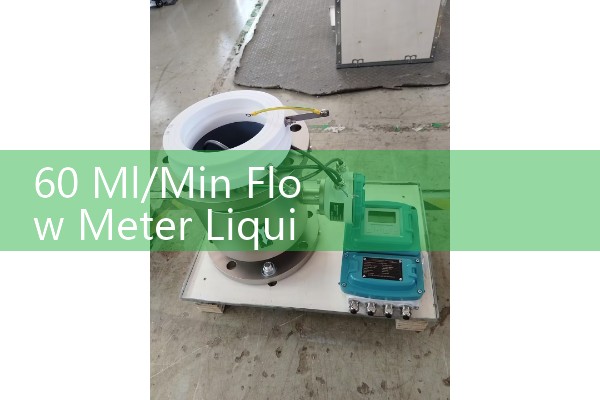
Micro Coriolis mass flow meters read mass directly. They ignore viscosity, density shifts, and temperature swings. A DN3 meter from Silver Instruments covers 0.3 to 6.0 kg/h, which fits 60 ml/min with plenty of turndown. The meter outputs a raw mass pulse and 4-20 mA HART. Validation becomes a matter of comparing totalised grams on the display against a precision balance.
Oval gear flow meters work well for viscous or non-conductive fluids above 10 cP, like gear oil, glucose syrup, or printing ink. A miniature oval gear meter with PPS gears can measure 30 to 300 ml/min reliably. But here is the trap. Oval gear accuracy drifts when viscosity changes even 20 percent from the calibration fluid. You must re-run the validation if you switch from a 50 cP lot to a 120 cP lot.
Pre-Validation Setup Details
Mount the meter vertically with flow going upward. This helps sweep out air pockets. Use a stiff connection. Avoid flexible tubing that absorbs pulses. Install a back-pressure valve downstream set 0.5 to 1.0 bar above atmospheric pressure. A simple spring-loaded check valve works. This small back pressure keeps dissolved gas in solution and stops cavitation at the miniature internal gears or oscillating tubes.
Place a precision balance with 0.01 g resolution at the dispense point. Use a beaker with a lid to limit evaporation. Connect the metre pulse output or 4-20 mA signal to a paperless recorder. Set the logging interval to 0.2 seconds so you can see instantaneous spikes later.
Step-By-Step Validation Routine for 60 Ml/Min
Step 1. Flush the line with your process liquid for 10 minutes at 80 ml/min. This stabilizes the metal temperature and wets all surfaces. Watch the recorder trace until it sits flat.
Step 2. Close the downstream valve completely. Wait 60 seconds. Perform an auto-zero on the Coriolis transmitter or hold the oval gear rotor still and zero the display. The baseline should read 0.00 g/min with no drift.
Step 3. Set the pump to exactly 60 ml/min. Use a screw-driven peristaltic or gear pump with a speed knob. Let the stream stabilise for 2 minutes.
Step 4. Tare the balance. Start the stopwatch and catch the dispensed liquid for exactly 120 seconds. This gives you a target mass of about 120 g for water-like fluids. Record the flo
Step 5. Repeat the catch test five times without touching the setup. Write down each pair of values: meter total and balance weight. Compute the percentage deviation for each run.
Step 6. Find the average deviation and the standard deviation across five runs. A good target is an average error below 0.5 percent and a standard deviation below 0.2 percent for a micro Coriolis. For an oval gear meter on 30 cP fluid, accept an average error below 1.0 percent.
Step 7. Adjust the K-factor if you use a pulse output meter. Enter the average correction into the transmitter. Re-run three cycles to lock in the new factor. Then print a validation report straight from your paperless recorder.
Things That Break Validation Without You Noticing
Air bubbles smaller than 0.5 mm can hide in a T-piece. A sudden temperature shift of 5 °C in the liquid changes the tube stiffness inside a Coriolis meter and shifts the zero point. A pump pulse dampener set too soft creates flow oscillations at 2 Hz that the totaliser averages out but your weigh scale sees. A drain line that siphons during the catch test pulls liquid back and ruins the weight. A cold workshop floor below 15 °C makes the electronics drift on an oval gear meter with passive pickups.
We solved a weird case for a paint ingredient supplier in Vietnam. Their validation data looked perfect in the morning but drifted after 2 PM. The sun heated the stainless steel pipe and created thermosiphon flow during the zero check. The meter re-zeroed against that creep. A simple shade cover fixed it.
Silver Instruments Model Guide for 60 Ml/Min Dispensing
Micro Coriolis flow meter SCM-DN3. Flow range 0.3 to 6.0 kg/h. Accuracy 0.2 percent of rate. Wetted parts 316L stainless steel. Process connection 1/8 inch NPT or tri-clamp. Outputs include pulse, 4-20 mA HART, and RS485 Modbus. Explosion-proof ATEX Zone 2 optional. Fluid temperature up to 120 °C. Works with liquids from 0.5 cP to 300 cP without recalibration.
Mini oval gear flow meter OGF-MINI-DN4. Flow range 1.8 to 18 l/h (30 to 300 ml/min). Accuracy 0.5 percent for viscosities between 5 and 500 cP. Gears available in PPS or aluminium. Pulse output standard, 4-20 mA via external converter. Not for water-thin solvents below 5 cP because slip increases.
Five Key Questions Engineers Ask About 60 Ml/Min Validation
Can a magnetic flow meter handle 60 ml/min of water? Only with a very small DN2 or DN3 tube and a high-end converter. Silver Instruments does not recommend it for batch validation because the low flow velocity makes the reading unstable under 30 cm/s.
What repeatability can I expect at 60 ml/min? With a properly zeroed micro Coriolis meter, repeatability normally falls between 0.1 and 0.25 percent. Oval gear repeatability sits around 0.3 to 0.5 percent if viscosity remains constant.
Do I need to validate every production batch? Not always. Validate after any fluid change, after maintenance, or quarterly for GMP environments. Log the K-factor history in your paperless recorder. This traceability saves you during an audit.
How do you measure high-viscosity fluids at this rate? Use the OGF-MINI oval gear meter with a heated sensor head if the fluid drops below 15 °C. Keep back pressure stable. Perform a viscosity check with a benchtop viscometer before each validation run and note the cP value on the report.
What outputs do these meters support for validation logging? Pulse output for totalizing, 4-20 mA HART for instantaneous flow, and RS485 Modbus for digital polling. Pair with a Silver Instruments paperless recorder to store raw data and auto-generate PDF validation reports.
Send us your fluid type, viscosity in cP, pipe size DN, required accuracy, and operating pressure to www.flow-meter.com.au. We will propose a 60 ml/min metering package with a validation procedure that fits your filling line.
 Hot Product
 Related AD